REVIEW · TRUJILLO
Guided Tour of Historic and Monumental Trujillo
Book on Viator →Operated by TurismoTrujillo.es Actividades Turisticas · Bookable on Viator
Two hours can change how you see Trujillo. I love how this tour links Plaza Mayor to the maze of the medieval walled center, so the city’s history feels connected instead of random plaques. I also like the guide’s focus on photo-ready corners, which helps you spot the best angles without wasting time guessing.
One thing to consider: this is a fast-moving walking circuit. You’ll be on your feet for about the full 2 hours, so comfortable shoes matter.
In This Review
- Key highlights you’ll notice right away
- Entering Trujillo’s walled core: what makes it work
- Plaza Mayor: where the story starts with Pizarro and Renaissance façades
- Palacio de San Carlos: the Plateresque façade trick
- Francisco Pizarro’s equestrian monument: more than a statue
- The Historic Centre Circuit: Muslim alcazaba, walls, strong houses, and church spires
- Casa-fuerte de Luis de Chaves El Viejo: a pause on who stayed where
- Palacio Viejo o de la Cadena: the Military Order of Santiago angle
- Castillo de Trujillo and the aljibe: defensive engineering you can still sense
- Pizarro House Museum: how an aristocratic home reads today
- Iglesia de Santa Maria la Mayor: Gothic over Romanesque + the Torre Julia
- Casa Fuerte de los Escobar: medieval military construction tied to a name
- Triumph Gate, Bejarano Redoubt, and Puerta de San Andrés: reading the wall
- Price and value: $13.90 for a 2-hour monument sampler
- Who should book this tour (and who might not love it)
- Should you book the Guided Tour of Historic and Monumental Trujillo?
- FAQ
- Where does the tour start and end?
- How long is the tour?
- How much does it cost?
- Do I need to print anything?
- Is the tour limited to a certain group size?
- What language or type of guided explanation should I expect?
- Are there admission tickets at the stops?
- Is free cancellation available?
- Can I bring a service animal?
- Is it easy to reach the meeting point with public transportation?
Key highlights you’ll notice right away
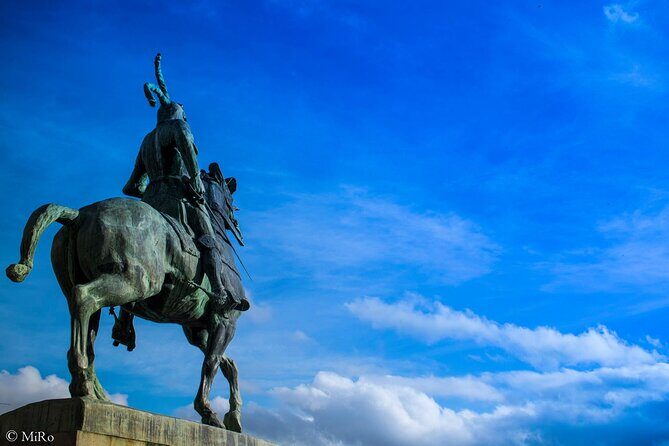
- Plaza Mayor orientation at the start, with Renaissance palaces and Francisco Pizarro’s equestrian statue in easy view
- Palacio de San Carlos and its Plateresque façade details, including the frontage offered to Domingo Street
- Medieval walls and the Muslim alcazaba area, plus strong houses, manor houses, palaces, convents and churches in one loop
- Castle de Trujillo with the long-lived Muslim fortress elements, including the aljibe (cistern)
- Gothic Santa Maria la Mayor layered over earlier Romanesque remains, with the Torre Julia and a Spanish-Flemish altarpiece
- Triumph Gate and the gates of the wall (Puerta de San Andrés), so you see Trujillo’s defenses as architecture, not just history
Entering Trujillo’s walled core: what makes it work
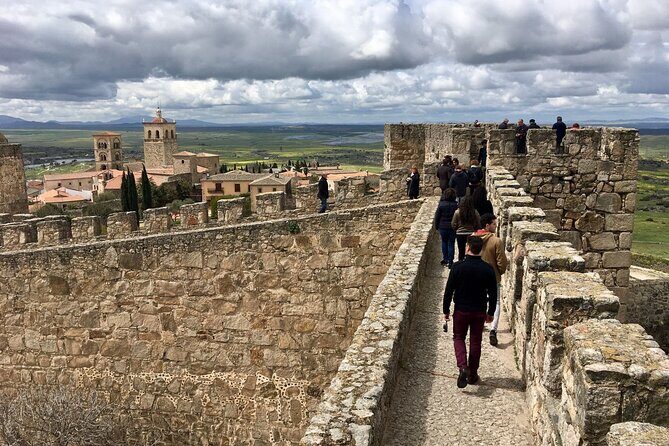
Trujillo is one of those Spanish towns where the streets feel like they were built to guide your feet. This tour does that job for you. You start in the center, then gradually move inward—step by step—until the medieval walls, strong houses, and monuments start to click into a single picture.
I especially like that the experience isn’t just “look at this building.” The flow matters. You get to stand in plazas, then move toward the fortifications, then land in churches and palaces. That rhythm helps you understand why the city looks the way it does, and why so many important people wanted to live here.
At a practical level, it’s also good value for time. At about 2 hours, you cover a lot of ground without the fatigue of a full-day outing. And because the stops you’re taken to are listed as free admission, you’re not constantly checking which parts cost extra once you’re already there.
You can also read our reviews of more guided tours in Trujillo
Plaza Mayor: where the story starts with Pizarro and Renaissance façades
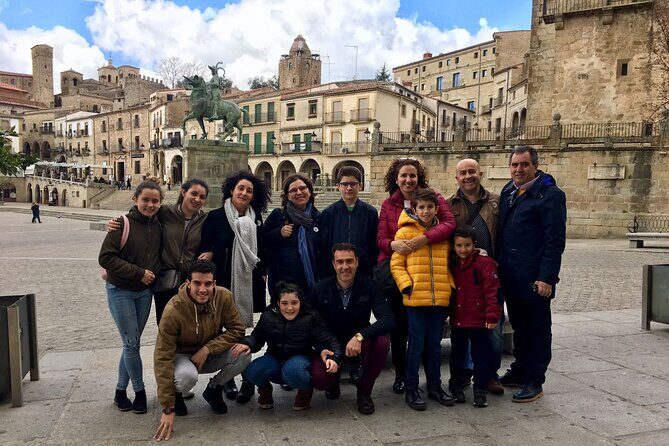
Your tour begins at Plaza Mayor de Trujillo, a square designed for impact. You’ll see Renaissance palaces around you, and right in the middle you’ll have the equestrian sculpture of Francisco Pizarro. Even if you only know Pizarro as a name, the monument helps anchor the theme of explorers and power that runs through Trujillo’s identity.
Then you’ll get another look at Plaza Mayor—because it’s not a one-note stop. There’s an underlying layer of 16th-century construction here, starting around 1562 by order of Hernando Pizarro. That matters because it explains why the square feels both grand and purposeful.
What I’d do on your own, right after the tour: take a minute to look up from where the group stops. The façades around Plaza Mayor reward that habit. It’s the difference between seeing a square and learning how it’s composed.
Potential drawback: if you’re expecting a lot of sitting and lingering, this stop is more about orientation and moving on. It’s short, efficient, and meant to set your bearings.
Palacio de San Carlos: the Plateresque façade trick
Next comes Palacio de San Carlos, also known as the Palacio de los Vargas-Carvajal. This is one of those buildings where the details are the point. It’s Plateresque—meaning a façade style known for ornate stonework that looks almost metal-work precise.
The tour highlights how the building keeps its original Plateresque façade, and also shows you an additional frontage offered to Domingo Street. That’s a helpful lesson in itself: in places like Trujillo, architecture isn’t just decoration. It’s how buildings announce status, connect to streets, and adapt over time.
Why it’s worth your attention: if you rush past Plateresque, you miss the texture and depth. On this tour, you’re guided to notice what makes it distinctive, and you’ll know what to look for when you pass similar façades later.
Photo tip: try one shot from slightly back and another from closer up. Plateresque details often change dramatically depending on how near you stand.
Francisco Pizarro’s equestrian monument: more than a statue
Right after Palacio de San Carlos, you’ll get a quick stop for the Francisco Pizarro equestrian monument. It’s brief, but it’s not meaningless. It keeps the tour’s “who mattered here” thread going, linking the architecture around you to the people the town associated with authority and expansion.
If you’re a history person, the statue is a natural pause. If you’re not, it still works because it’s visually dominant, so your brain stays oriented in a town full of similar-looking stone streets and doors.
The Historic Centre Circuit: Muslim alcazaba, walls, strong houses, and church spires
This is the heart of the experience: the medieval historic center, which includes the Muslim alcazaba and the walls, plus strong houses, manor houses, palaces, convents and churches.
This stop is basically the tour’s “how the town worked” phase. Instead of trying to memorize dates, you’re learning the spatial logic—where defenses were, where elite residences clustered, and how religious buildings fit into the same tight urban fabric.
The best part is that you don’t have to do the detective work alone. The guide’s job is to point out what makes each cluster distinct: what feels defensive, what feels noble, and what signals spiritual importance. And because you’re moving through the streets instead of reading from a book, you actually build a mental map.
Who this phase is best for: if you like authentic atmosphere, this is it. Even in 2 hours, you’ll feel the medieval town vibe more strongly than you would if you only visited the biggest sights.
Where you might feel friction: if you dislike walking between stops, this section could feel like a lot. But it’s also the section where the tour becomes more than a checklist.



Casa-fuerte de Luis de Chaves El Viejo: a pause on who stayed where
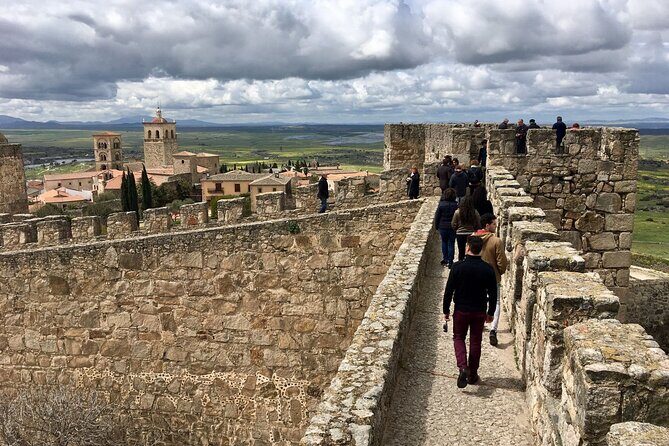
You’ll then step into the Casa-Fuerte de Luis de Chaves, known as El Viejo. This strong house dates to the 13th and 14th centuries. The tour notes that the Catholic Monarchs stayed here during the Wars of Succession.
This is the kind of stop that connects “big names” to physical spaces. Strong houses weren’t just for show. They were built for control and safety. When you see one in person, you start to understand why Trujillo could function as a residence of kings and not just a picturesque town.
If you like social history—who lived where, and why you should care—this stop helps you see power as something built into the street plan.
Palacio Viejo o de la Cadena: the Military Order of Santiago angle
Next is Palacio Viejo o de la Cadena, a 13th-century church founded by the Military Order of Santiago.
This matters because it gives you another layer: Trujillo wasn’t only royal and civic. It also had religious-military influence, and that influence left architecture behind. Even if you can’t spot every stylistic cue instantly, the guided explanation helps you place the building in a broader story of medieval institutions.
Practical thought: take a moment here to look for transitions—where older religious elements meet later changes. Places with multiple eras often feel “busy” up close, but the guidance makes the busy parts feel purposeful.
Castillo de Trujillo and the aljibe: defensive engineering you can still sense
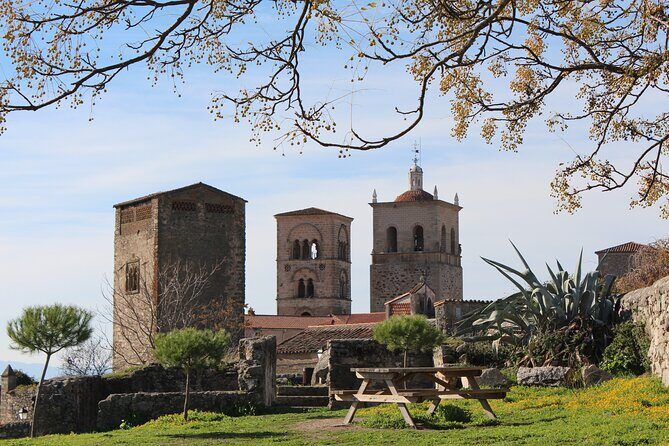
The Castillo de Trujillo stop is a major highlight. You’ll see Muslim alcazaba elements and the aljibe from the 10th to 12th centuries.
An aljibe is a cistern—water storage. That one detail can change how you picture a fortress. You’re no longer thinking only about walls and towers. You’re thinking about survival, supply, and why a fortified place could last through difficult periods.
What you’ll get from the tour here: you’re guided to understand which parts belong to the fortress mindset and which parts connect to later use. You leave with a clearer sense of what “castle” means in a town like Trujillo.
Drawback to consider: if you hate heights or uneven ground, you should be cautious. Castles often mean irregular footing, and this is still a walking tour.
Pizarro House Museum: how an aristocratic home reads today
Then you’ll visit the Pizarro House Museum, described as the manor house of an hidalgo from the 15th century.
This is where the tour shifts from fortifications to domestic power. A manor house tells you how status behaved daily. It’s not just about wealth. It’s about who had space, how rooms were arranged, and how elite life looked behind exterior stone.
Even if you don’t go deeply into museum-style interpretation, the value here is orientation. The tour helps you see how the same town that protected itself also hosted the people who influenced events far beyond Trujillo.
Iglesia de Santa Maria la Mayor: Gothic over Romanesque + the Torre Julia
One of the strongest stops is Iglesia de Santa Maria la Mayor, declared a Gothic church national monument, with earlier Romanesque remains such as the Torre Julia. The tour also calls out a Spanish-Flemish altarpiece by Fernando Gallego.
That mix—Gothic and Romanesque in the same site—means you’re looking at layers of time, not a single frozen moment. And the Torre Julia reference is a great way to understand why church complexes can feel both unified and complicated.
The Fernando Gallego altarpiece angle gives you something specific to look for. Even if you’re not an art specialist, knowing the name helps you focus your attention instead of just taking in the room.
Casa Fuerte de los Escobar: medieval military construction tied to a name
Next up is Casa Fuerte de los Escobar, a 15th-century military construction where the first woman said to have brought wheat and barley seeds to Peru, María de Escobar, lived.
This is a memorable pivot. It’s not only about walls and monuments. It’s about people and stories tied to what Trujillo sent out into the wider world. The tour uses this stop to connect the local built environment to a global historical thread.
If you like human stories, this is one of those moments that sticks after you’ve finished walking.
Triumph Gate, Bejarano Redoubt, and Puerta de San Andrés: reading the wall
Later you’ll see the Triumph Gate, then the Bejarano Redoubt, a strong house from the 13th century that defended the Puerta del Triunfo. Finally, you’ll visit Puerta de San Andrés, one of the seven gates of the wall next to the Church of San Andrés.
This whole sequence is excellent because it forces you to treat the city wall like a living system. Gates aren’t just openings. Redoubts aren’t just extra walls. They’re tools for controlling movement—who enters, who exits, and how defense works at street level.
What you’ll likely notice: as you move from one gate to another, the town’s layout becomes easier to read. Even if the stones feel similar, the placement tells you what mattered.
Photo tip: gates are depth scenes. Try one shot straight-on and one angled from the side so you catch the passage and the defensive feel.
Price and value: $13.90 for a 2-hour monument sampler
The tour costs $13.90 per person for about 2 hours, with a mobile ticket. It’s also limited to a maximum of 30 travelers, which usually helps keep the pace lively and the guide’s explanations from getting swallowed by a crowd.
Here’s why I think the value is strong: you’re guided through a dense cluster of major landmarks—plazas, palace façades, fortress elements, castles, churches, and gates—within a short time window. The stops listed are free admission, so you’re not stacking entry fees on top of the tour cost.
Also, it’s booked about 8 days in advance on average. That’s a hint to plan ahead, especially if you want a spot at a convenient time.
Who should book this tour (and who might not love it)
Book it if you want a guided “map made of monuments.” You like history that’s tied to physical places. You want to walk through Trujillo’s walled center and understand the logic of palaces, churches, and defenses without doing research between stops.
You might skip it if you need a slower, sit-down style of tour. The circuit moves. The best experience comes when you’re happy to keep walking and turning your attention to façades, gates, and key architectural details.
It’s also a good match for most travelers who can handle city walking. Service animals are allowed, and the meeting point is near public transportation, so it’s easier to fit into a day in Extremadura.
Should you book the Guided Tour of Historic and Monumental Trujillo?
Yes—if your goal is to understand Trujillo fast, this is the smart way to do it. For the price, you get an organized route through the town’s most important layers: Renaissance civic power in Plaza Mayor, Plateresque elegance at Palacio de San Carlos, fortress survival at the castle and cistern area, and the architectural mix inside Santa Maria la Mayor.
One more reason to feel confident: the tour is consistently rated 5 stars across hundreds of reviews, with strong praise for how complete and enjoyable the guide makes the walk. If you’re planning to explore Trujillo afterward on your own, this tour helps you know where to look next—and how to read what you’re seeing.
FAQ
Where does the tour start and end?
The tour starts at TurismoTrujillo.es Actividades Turísticas, Plaza Mayor, 20, 10200 Trujillo, Cáceres, Spain. It ends back at the same meeting point.
How long is the tour?
The guided experience lasts about 2 hours.
How much does it cost?
The price is $13.90 per person.
Do I need to print anything?
No. You get a mobile ticket.
Is the tour limited to a certain group size?
Yes. The maximum group size is 30 travelers.
What language or type of guided explanation should I expect?
The tour includes a guided walk that covers monuments and corners of Trujillo, with recommendations for more interesting photographic spots.
Are there admission tickets at the stops?
The stops listed are marked as free admission.
Is free cancellation available?
Yes. You can cancel up to 24 hours in advance for a full refund.
Can I bring a service animal?
Service animals are allowed.
Is it easy to reach the meeting point with public transportation?
Yes. The meeting point is near public transportation.